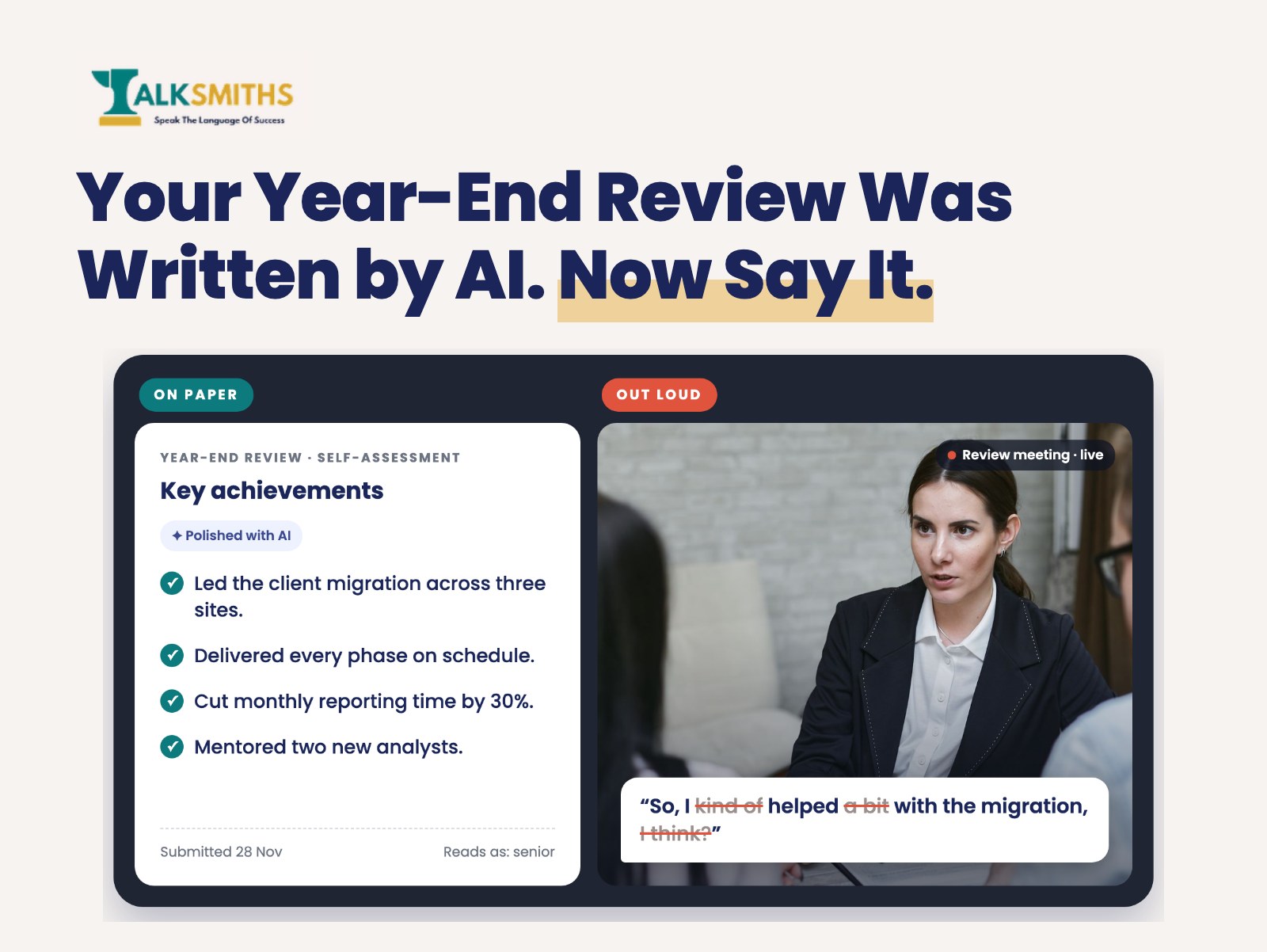
Your self-assessment went in on Friday. You wrote it, asked an AI tool to sharpen it, and it came back confident: led, delivered, cut reporting time by 30%. On Tuesday you sit down with your manager, who drafted your review with AI too. Then the conversation starts, and you hear yourself say "So, I kind of helped a bit with the migration, I think?"
The short answer. The written review is now polished on both sides, so it no longer separates anyone. The meeting does. It's where the raise, the promotion and next year's scope get decided, and it's the one part of review season nobody can draft for you. Say your results the way you wrote them: the verb you own, the number, the scope. Then stop.
Review season has quietly become an AI season
In a 2026 Highwire survey of 1,034 employees, 78% of managers said they had used AI to help write, edit or summarise feedback over the past year. Only 16% of non-managers were told AI had been involved. A separate Headway survey of 1,000 managers found that 57% have scripted or rehearsed a difficult conversation with AI before having it.
So the document in front of you was probably polished, and the person across the table may have rehearsed. The question is whether you did.
| Your manager | You | |
|---|---|---|
| The written review | Drafted or edited with AI | Self-assessment polished with AI |
| The conversation | Often rehearsed, sometimes with AI | Usually improvised |
| What gets decided | Rating, raise, scope | Whether you get them |
Why the meeting undoes the document
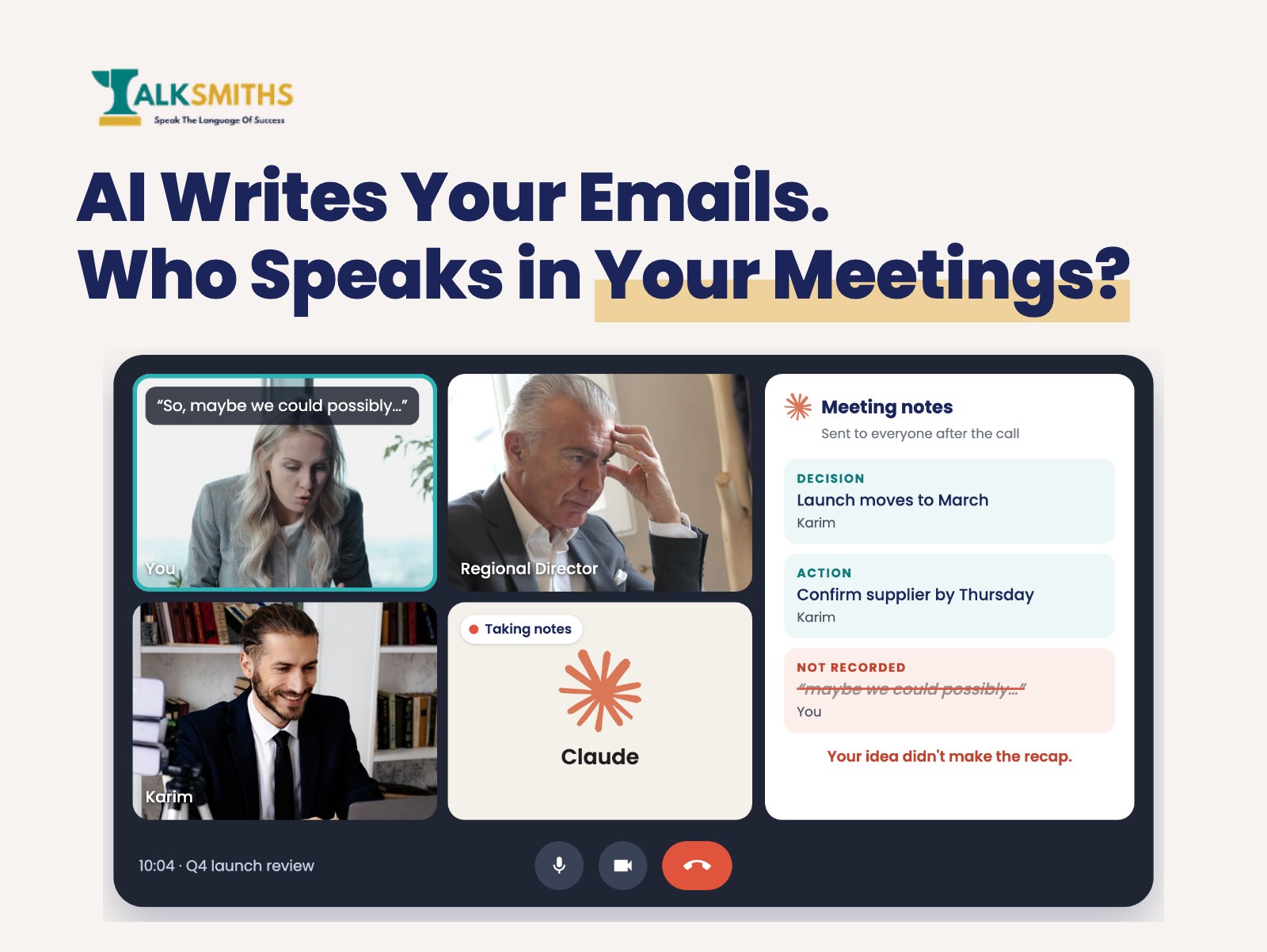
A strong self-assessment sets an expectation. When the spoken version is softer, the gap reads as doubt, and doubt lands on the version people hear live. We covered the general pattern in AI Writes Your Emails. Who Speaks in Your Meetings?. In a review the cost is higher, because the conversation ends with a number attached to your name.
The French layer
Many of the softeners we hear in reviews are French formulas translated word for word. Each one is polite. Together they shrink the year.
| The French habit | Said in English | What reads as senior |
|---|---|---|
| J'ai pu contribuer à… | I was able to contribute to… | "I led…" / "I delivered…" |
| J'ai essayé de… | I tried to… | "I did…", then the result |
| On a fait… | We did… | "I owned X. The team delivered Y." |
| Ce n'était pas grand-chose | It was nothing special | "It saved eleven days." |
| Si c'est possible, j'aimerais… | If it's possible, I would like… | "I'd like to discuss the senior role." |
What it sounds like
Talking about a result
What gets said
“So, I kind of helped a bit with the migration, I think? It went okay, more or less.”
Three hedges, no number, and the credit handed away.
Senior
“I led the client migration across three sites. Every phase landed on schedule.”
The same facts as the self-assessment, said with the same verb.
Answering feedback you disagree with
What gets said
“Okay, yes, maybe, I understand. I'll try to do better.”
Agrees with a point you don't accept, on the record.
Senior
“I see it differently. The Q3 delay came from the supplier, and I flagged it in August. Can we note that?”
Polite, specific, and it asks for the record to change.
Asking about next year
What gets said
“If it's possible, maybe one day I would like to maybe have more responsibilities?”
So many qualifiers the request disappears.
Senior
“I'd like to discuss the team lead role for next year. What would you need to see from me by June?”
Names the role, then asks for the criteria.
“Your manager can only defend the version of your year that you said out loud.”
How to prepare the conversation, not just the document
Five habits for the review AI can't sit for you
- 1
Pick your three lines
Choose the three results you want remembered. Write each as one sentence with a verb you own and a number. Those are what you say first, before anything else.
- 2
Say them out loud, twice
Read them aloud the day before, then once more without the page. If a sentence only works on paper, rewrite it until it works in your mouth.
- 3
Rehearse the hard question
Ask an AI tool to play your manager and give you the toughest piece of feedback it can find in your self-assessment. Answer out loud. Your manager may have rehearsed; this is how you match them.
- 4
Prepare one sentence for disagreement
"I see it differently, because…" plus one fact. Polite, short, and it puts your version on the record.
- 5
End with the ask
Close with what you want next year: the role, the scope, the raise. Then ask what would need to be true by a date. Silence after the ask is fine.
What this looks like in practice
An analyst preparing her first English-language review
An operations analyst in Casablanca reports to a regional manager in Madrid. Her self-assessment, polished with AI, is the strongest on the team. In last year's review she credited the team for everything, agreed with feedback she thought was unfair, and never mentioned the promotion she wanted. The written review was excellent. The rating was average.
This year the document barely changed. What changed was three spoken sentences she had practised out loud, one line for disagreeing, and an ask at the end.
3
Results said first, with numbers
1
Sentence ready for disagreement
1
Clear ask to close the meeting
An illustrative composite of patterns we see in review coaching, not a single named client.
Questions people ask us
Should I tell my manager I used AI on my self-assessment?
If your company has a policy, follow it. Either way, make sure every line in the document is something you can say and defend in your own words. If you can't explain a sentence out loud, take it out.
Isn't saying "I led" arrogant?
Not when it's accurate. Name the team where the team did the work, and name your part where it was yours. Precise credit sounds confident. Vague modesty sounds unsure.
My English is good. Why do I undersell myself only in reviews?
Because a review is high-stakes, live and about you, which is exactly when first-language habits take over: the courtesy formulas, the shared credit, the soft ask. It's a habit to train, not a level of English to fix.
Can a whole team work on this before review season?
Yes. Teams share the same habits because they share a first language and a culture. We train teams on the conversations they actually face, from beginners to senior managers, and review preparation is one of the fastest wins.
What to take away
- Most managers now use AI on feedback, and few employees are told. The documents are polished on both sides.
- The review meeting decides the rating, the raise and next year's scope, and it can't be drafted for you.
- French and Moroccan modesty formulas shrink your year in English. Use the verb you own and the number.
- Prepare three spoken lines, one sentence for disagreement, and a clear ask.
- Say them out loud before the meeting. A sentence that only works on paper won't work in the room.
Based on 5,000+ hours training professionals at Deloitte, Baker Tilly and Kedrion across four continents.
Make your review sound like your self-assessment
We build programmes around the conversations your people actually have, like the year-end review, the client call and the update to head office. Book a free 30-minute demo with Daniela. It's a video call, and there's nothing to prepare. Become a Talksmith. Speak The Language Of Success.
Statistics are quoted as published by the sources named alongside them. Scenarios marked “what this looks like in practice” are illustrative composites of patterns across our programmes, not the results of a single named client.