
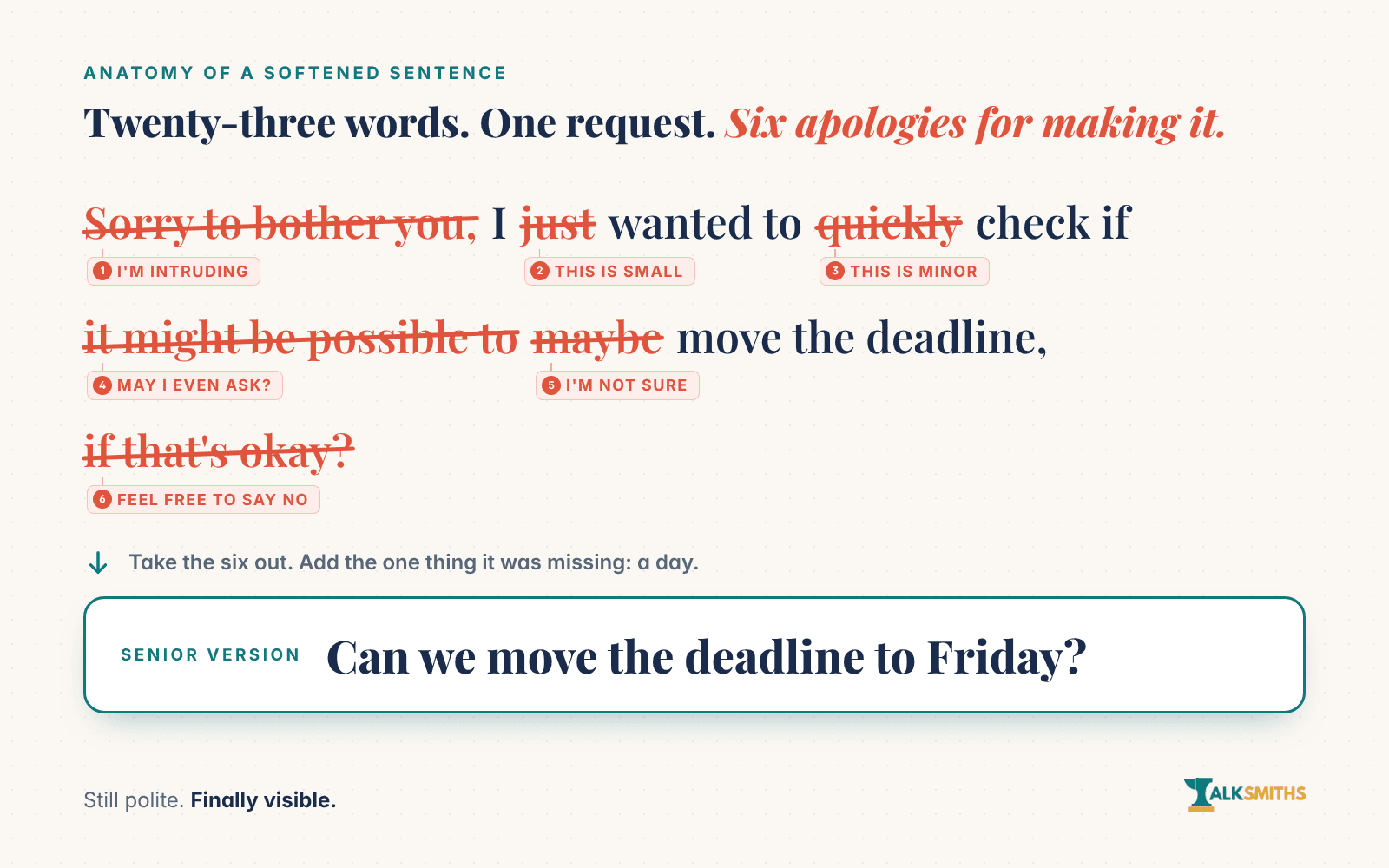
A finance director sends this to her counterpart at head office: "Sorry to bother you, I just wanted to quickly check if it might be possible to maybe move the deadline, if that's okay?" Every word is correct. Now read it as the person receiving it. Twenty-three words, one request, and six separate apologies for making it.
The people we train already speak English well. What holds them back is rarely grammar or vocabulary. It is a handful of small words that do useful social work in their first language and quiet damage in English, because each one tells the listener how much weight to give whatever comes next.
What the small words are actually doing
None of these words is a mistake. Each has a job: asking permission, lowering the stakes, protecting the relationship. The trouble is the second job they do without asking you. They set the price of your point before anyone has heard it.
| The word | What you mean | What the room hears | Say instead |
|---|---|---|---|
| "Sorry" (to open) | I'm being considerate | I'm intruding | Start with the point, thank them at the end |
| "Just" | This is small, don't worry | Don't take this seriously | Delete it. Nothing is lost |
| "Quick" / "quickly" | I respect your time | This is minor | Name the time: "Two minutes on the budget." |
| "I think maybe" | I'm open to other views | I'm not sure | "I recommend…" / "My view is…" |
| "I'm not an expert, but" | I'm being modest | Discount what follows | Give the basis: "From the Q3 numbers…" |
| "Kind of" / "sort of" | Roughly | Vaguely | Give the figure or the range |
| "Does that make sense?" | Checking I was clear | I doubt I explained it | "What would you change?" |
| "Would it be possible to…" | Polite request | Permission to have a view | "Can we…" / "I'd like to…" |
Try it
Spot the softeners
1/3
Tap every word that shrinks the speaker. Then reveal the rewrite.
, , ?
Why fluent speakers soften more, not less
You would expect the habit to fade as English improves. Often it grows. Better English means more exposure to the polite register of native speakers, and the padding is the easiest part of that register to copy. What doesn't copy over is the status that lets a native speaker soften safely.
The French and Arabic layer
In Casablanca and Rabat many of the softeners we hear are translations. Formal French correspondence runs on courtesy formulas that are elegant in French and arrive in English sounding hesitant, or simply wrong. They are not errors of English. They are good French manners in the wrong language.
| The French habit | Translated literally | What reads as senior |
|---|---|---|
| Je me permets de vous relancer | I allow myself to remind you | "Following up on Tuesday's email:" |
| Désolé de vous déranger | Sorry to disturb you | "Thanks for a minute on this." |
| Pourriez-vous éventuellement… | Could you eventually… | "Could you send it by Thursday?" |
| Je voulais juste savoir si… | I just wanted to know if… | "Is the contract signed?" |
| N'hésitez pas à revenir vers moi | Don't hesitate to come back to me | "Call me if anything is unclear." |
Darija and Arabic courtesy works the same way. A warm formula that signals goodwill at home can read, to a reader in London or Paris, as a lack of commitment. "Hopefully by Friday, God willing" is a kindness in Casablanca and a hedge in a project tracker. We covered the wider version of this in Lost in Translation: the damage is rarely linguistic. It is the meaning that travels.
The same message, written twice
Asking for a deadline change
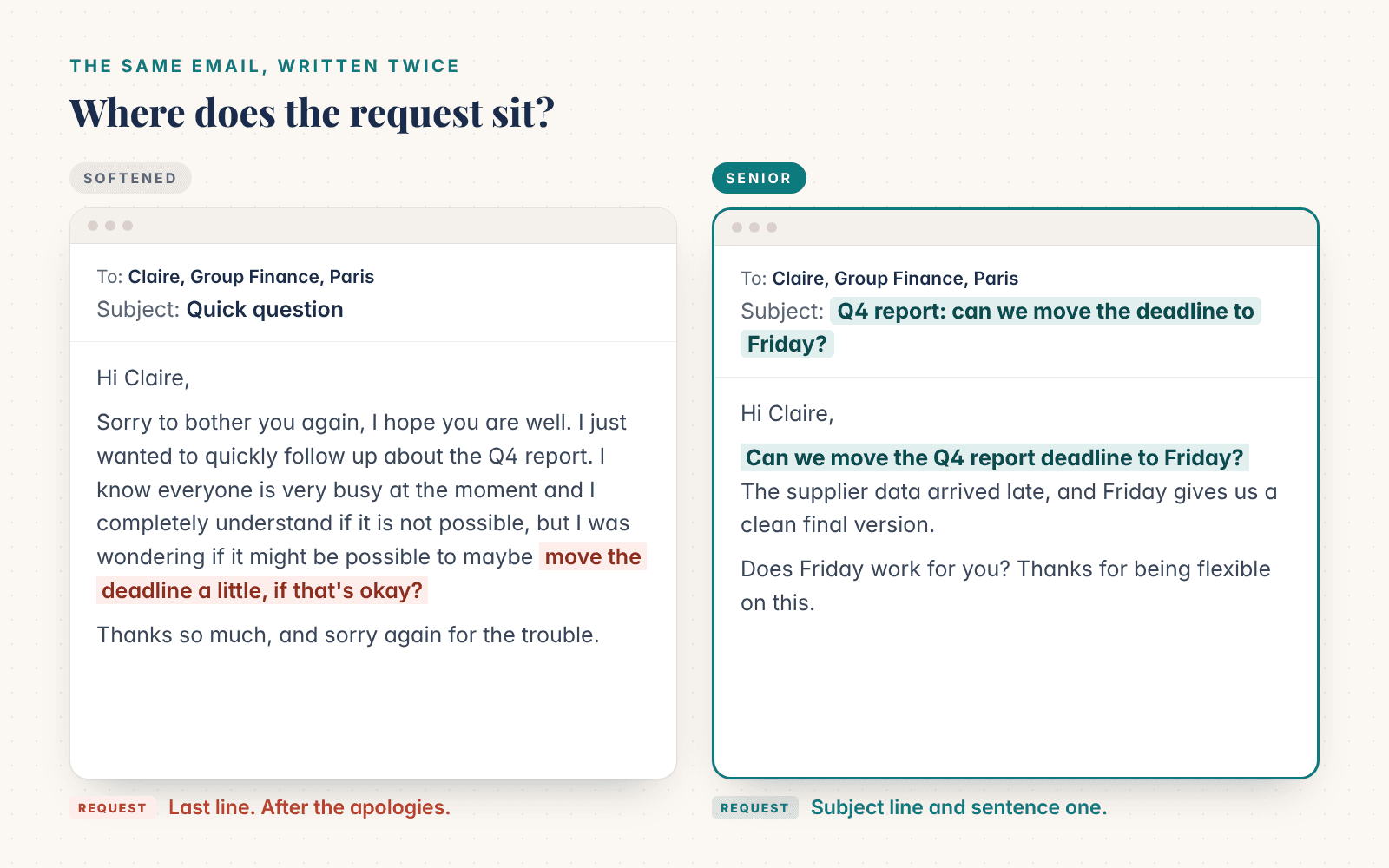
Softened
“Sorry to bother you, I just wanted to quickly check if it might be possible to maybe move the deadline, if that's okay?”
The request arrives last, after six apologies for making it.
Senior
“Can we move the deadline to Friday? The supplier data arrived late, and Friday gives us a clean final version. Thanks for being flexible on this.”
Ask, reason, warmth. Same politeness, in the right order.
Disagreeing in a meeting
Softened
“Sorry, I'm not sure, but maybe we could possibly look at another option? Just an idea.”
Four hedges ask the room to ignore the objection.
Senior
“I see a risk in this plan. Can I take two minutes on an alternative?”
States the position, then asks for exactly what it needs.
Soften the relationship, never the content
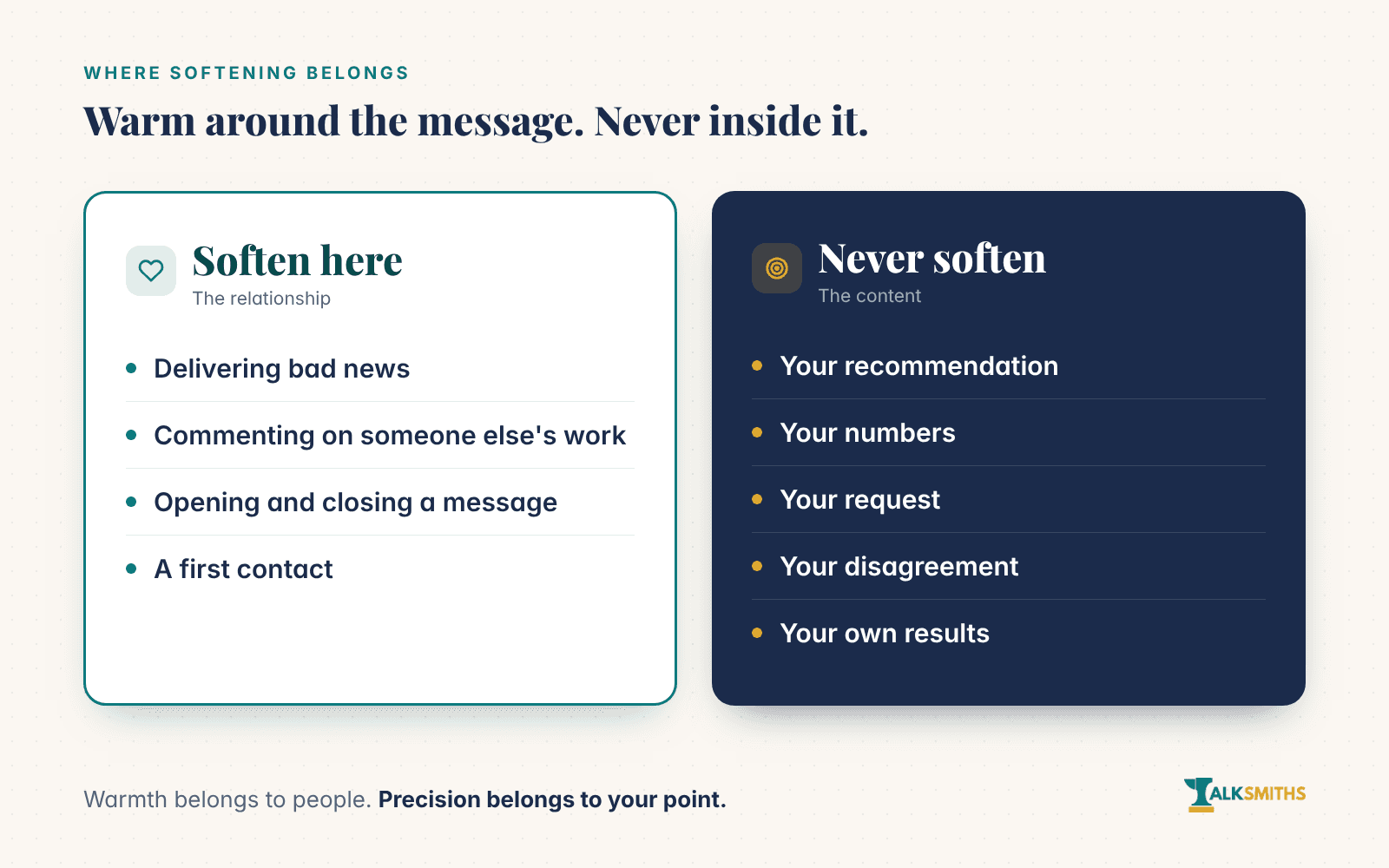
None of this is an argument for bluntness. The most senior people we work with are often the warmest people in the room. The difference is where the warmth goes: around the message, never inside it. A thank-you at the end costs nothing. A "maybe" in front of your recommendation costs the recommendation.
“Politeness is how you treat the other person. Seniority is how you treat your own point.”
The five-minute softening audit, before you press send
- 1
Search and delete.
Find sorry, just, quick, maybe and I think. Delete every one and reread. Put back only the ones you genuinely miss. It is usually none.
- 2
Move the ask to line one.
If the reader stopped after the first sentence, would they know what you need? If not, the request is in the wrong place.
- 3
Replace hedges with sources.
"I think the cost is around 40k" becomes "Procurement's quote is €38,500." Confidence comes from the basis, not the tone.
- 4
Keep one warm sentence, at the edge.
Open or close with it. Never put it between the reader and the request.
- 5
End with a question that expects a yes.
"Does Thursday work?" moves things. "Let me know if that might be possible" waits.
Where it costs the most: your own performance review
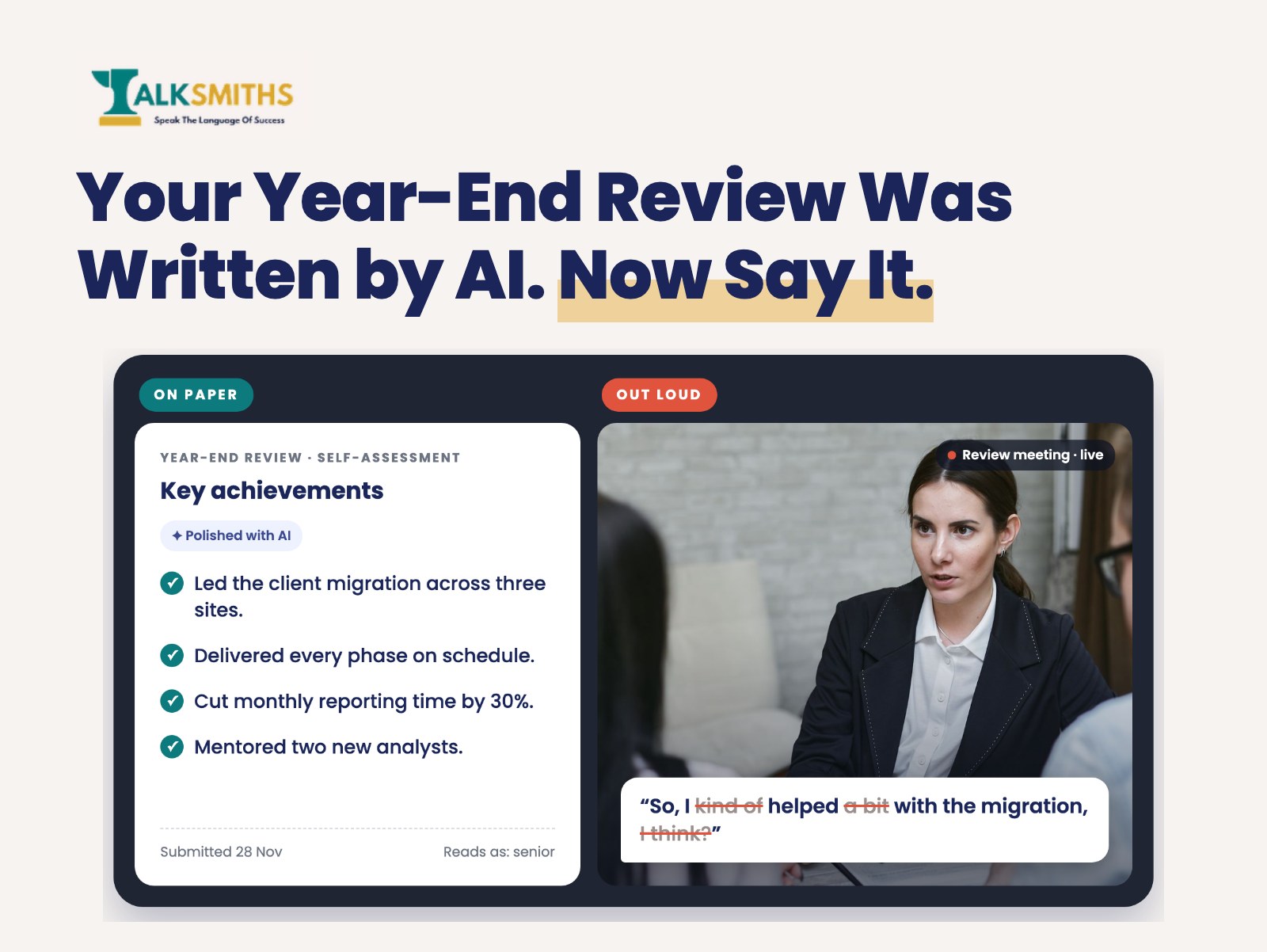
Year-end reviews are being written this month, and self-assessment is where softening does its most lasting damage: in writing, on file, read by people deciding on promotions. "I kind of helped with the client migration" is modesty in the moment and a weaker record for the next twelve months.
One line from a self-assessment
Softened
“I think I was able to help a bit with the client migration, and I tried to always meet the deadlines.”
Three hedges and a verb that hands the credit to someone else.
Senior
“I led the client migration across three sites and consistently delivered each phase on schedule.”
A verb you own, a scope, and an adverb that states a pattern.
Precise adverbs do the work hedges only hope to. "She consistently delivers on time" says what "she tries to always be on time" never quite claims.
What this looks like in practice
A finance lead writing to a European parent company
A finance lead in Casablanca manages the monthly close for a group headquartered in Paris. Her numbers are reliable and her English is fluent. Her emails open with an apology, put the request in the last paragraph, and wrap every figure in "around" or "I think". Head office reads them as uncertain, so they check her work twice, which slows the close she is responsible for. Nothing about her English needed to change. The order of her sentences did.
Line 1
Where the request now sits
0
Apologies before the point
Same
Warmth, moved to the sign-off
An illustrative composite of patterns we see across finance and operations teams, not a single named client.
What to take away
- Softeners are not errors. They are social signals, and in English they set the value of your point before anyone hears it.
- Fluent speakers often soften more, because padding is the easiest part of native politeness to copy.
- Many softeners in Moroccan teams are French or Arabic courtesy, translated. Good manners, wrong language.
- Soften the relationship, never the content: warmth at the edges, precision in the middle.
- Before you send, run the five-minute audit. Delete, move the ask up, replace hedges with sources.
Hear what your team's English is really signalling
We build programmes around the conversations your people actually have: the email to head office, the client call, the review. Book a free 30-minute demo with Daniela. It's a video call, and there's nothing to prepare. Become a Talksmith. Speak The Language Of Success.
Statistics are quoted as published by the sources named alongside them. Scenarios marked “what this looks like in practice” are illustrative composites of patterns across our programmes, not the results of a single named client.