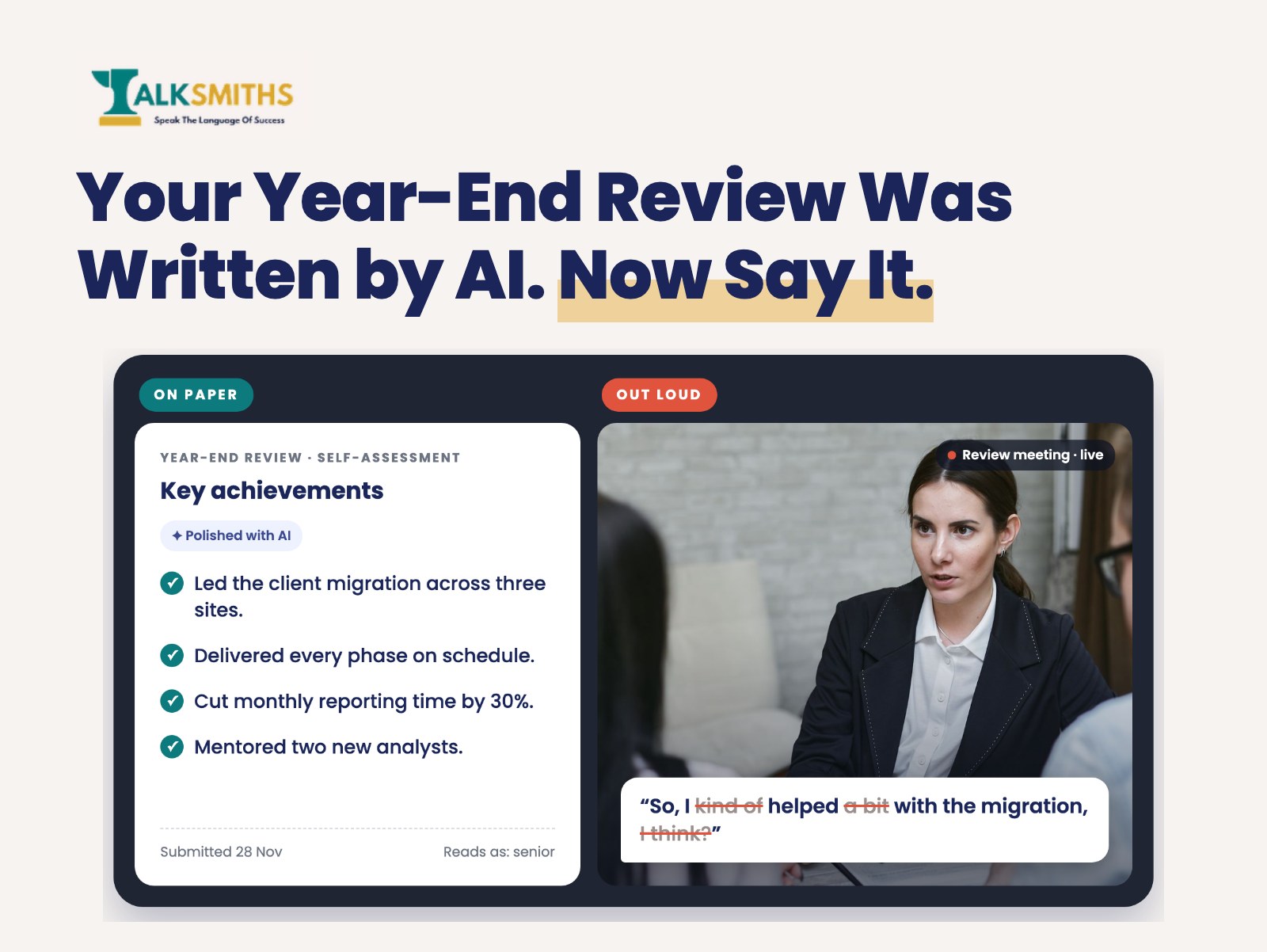
Your email to your manager went out at 9:12. You wrote it, asked an AI tool to tighten it, accepted two of its changes and sent a clean, confident page. At 10:00 the call starts, cameras on. There is no draft, no second opinion and no undo. Your manager is about to meet the other version of you.
The short answer. AI has raised the standard of everyone's written English, so your emails no longer tell anyone much about you. Meetings now do. When the person who writes and the person who speaks don't match, people believe the one they hear live. The fix is to prepare your spoken English the way you already edit your written English. Lead with the point, own the verb, and cut the cushions.
The email has a second opinion now. The meeting doesn't
This is no longer a habit of a few early adopters. In a 2026 Omni Calculator survey, 76% of workers said they run an email to their boss past AI before sending it, and almost as many do it for emails to colleagues. Managers were the most habitual checkers of any group. Only 7% routinely say when AI helped.
The same survey found a cost. One worker in three feels less confident in their own writing since they started using AI. A tool that checks every sentence teaches you, quietly, that your unchecked sentences are not good enough. Then you walk into the one place where every sentence goes out unchecked.
| Your email | Your meeting | |
|---|---|---|
| Time to think | As long as you like | About two seconds |
| Second opinion | AI, before you send | None |
| Can you edit it? | Until you press send | No |
| Who sees the polish | Everyone, so it no longer stands out | Everyone, so it stands out |
| What it shows | How well you edit | How you think |
Why the gap costs more in a second language
For professionals who work in English as a second language, the email used to be the safe ground. You could take your time, check a phrase, rewrite the opening. Now everyone's email is polished, so the written page no longer sets you apart. The live conversation does, and that is exactly where translating from French, Arabic or Hungarian slows you down and softens you.
People also judge AI-polished writing more harshly than writers expect. In a 2025 study of about 1,100 professionals in the International Journal of Business Communication, managers whose messages leaned heavily on AI were rated sincere by only 40 to 52% of employees, against 83% for low AI use. The room has learned to discount polish. What it still trusts is what you say without help.
AI is in the meeting now. It still can't speak for you
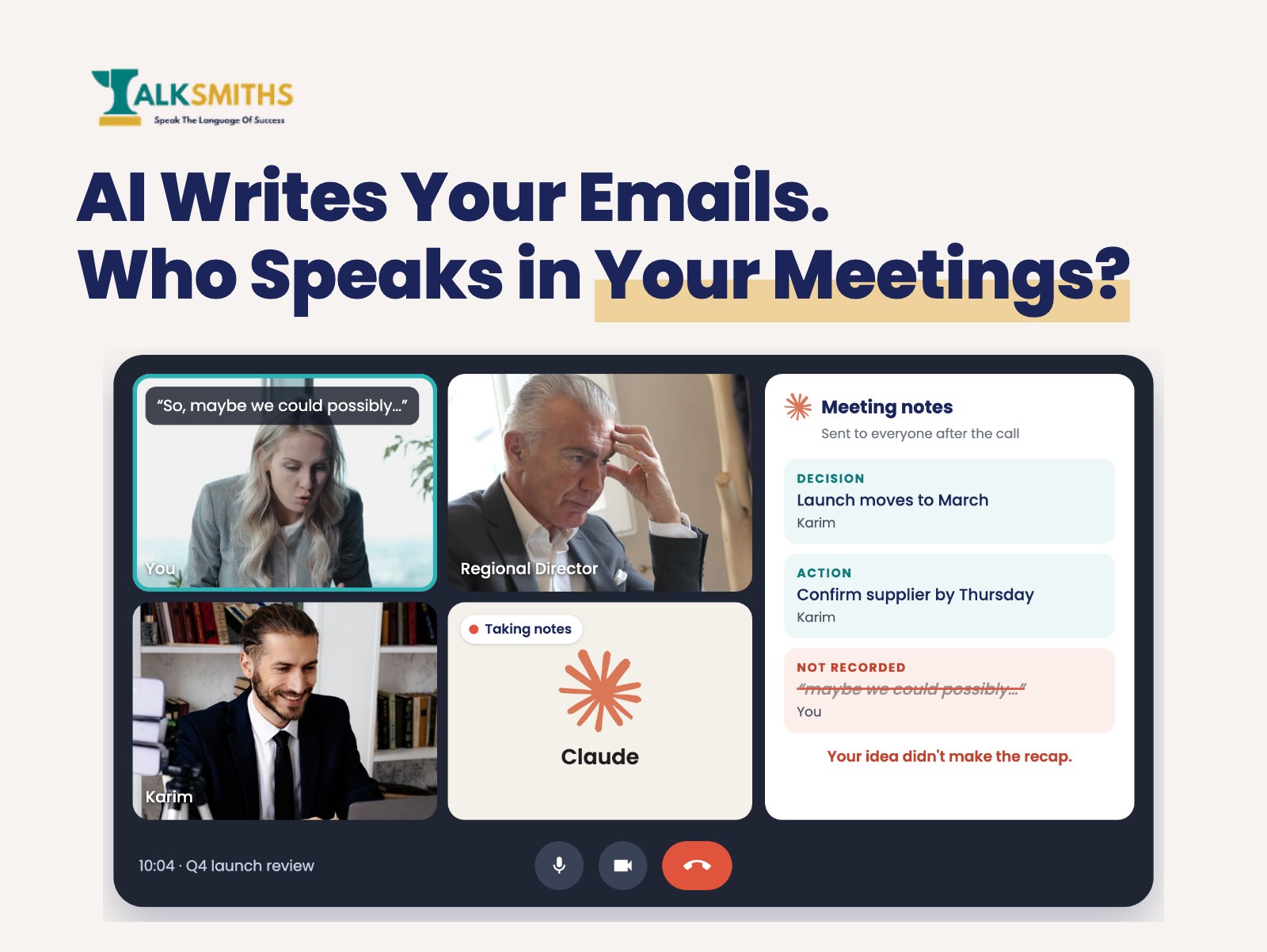
This month the AI moved from your inbox into the meeting itself. Anthropic launched Claude Meetings, which lets Claude join a Google Meet call as a participant. It takes notes, answers questions in the chat and drafts plans while people talk. Anthropic says Claude now sits in nearly all of its own meetings. Microsoft Teams, Zoom and Google Meet already do a version of the same with their built-in assistants.
So there is an AI in the room, and it is listening to you. What it cannot do is speak for you. It writes down what you said, in the words you chose, and sends the summary to people who weren't there. Often that summary is the only record anyone reads.
Summaries are built to pull out three things: decisions, owners and numbers. A hedged contribution contains none of them. "Maybe we could look at another supplier, just an idea" tends to vanish from the recap. "I recommend we switch to the Tangier supplier. It saves eleven days" comes back as an action with your name next to it. The AI that polished your email is now taking minutes on how you speak.
“If your sentence has no decision, no owner and no number, the summary has nothing to keep.”
What it sounds like
Giving an update
What gets said
“So, yes, I think we're more or less on track, there are just a few small things maybe, but overall it's kind of fine, I would say.”
No number, no risk named, nothing a summary can use.
Senior
“We're on track for the 15th. One risk, the supplier data is late. I'll confirm by Thursday.”
A date, a named risk and an owner, in three short sentences.
Disagreeing with a decision
What gets said
“Sorry, I just wanted to add something, maybe I'm wrong, but I'm not sure this is the best option?”
Three apologies before the objection. The room hears permission to ignore it.
Senior
“I'd push back on this. The cost assumes no delays, and we've had two this quarter.”
The position first, then the reason. It's still polite.
The French and Arabic layer
In Moroccan teams, many of the cushions in spoken English are French meeting formulas translated word for word. They sound courteous in a Casablanca boardroom and hesitant on a call with London.
| The French habit | Said in English | What reads as senior |
|---|---|---|
| Si je peux me permettre… | If I can allow myself… | "One point on the budget." |
| Je voulais juste ajouter… | I just wanted to add… | "To add to that," |
| Je ne sais pas si c'est pertinent, mais… | I don't know if it's relevant, but… | "This is relevant because…" |
| On pourrait éventuellement… | We could eventually… | "I suggest we…" |
| Voilà, c'est tout. | Voilà, that's all. | Stop. Let the silence do the work. |
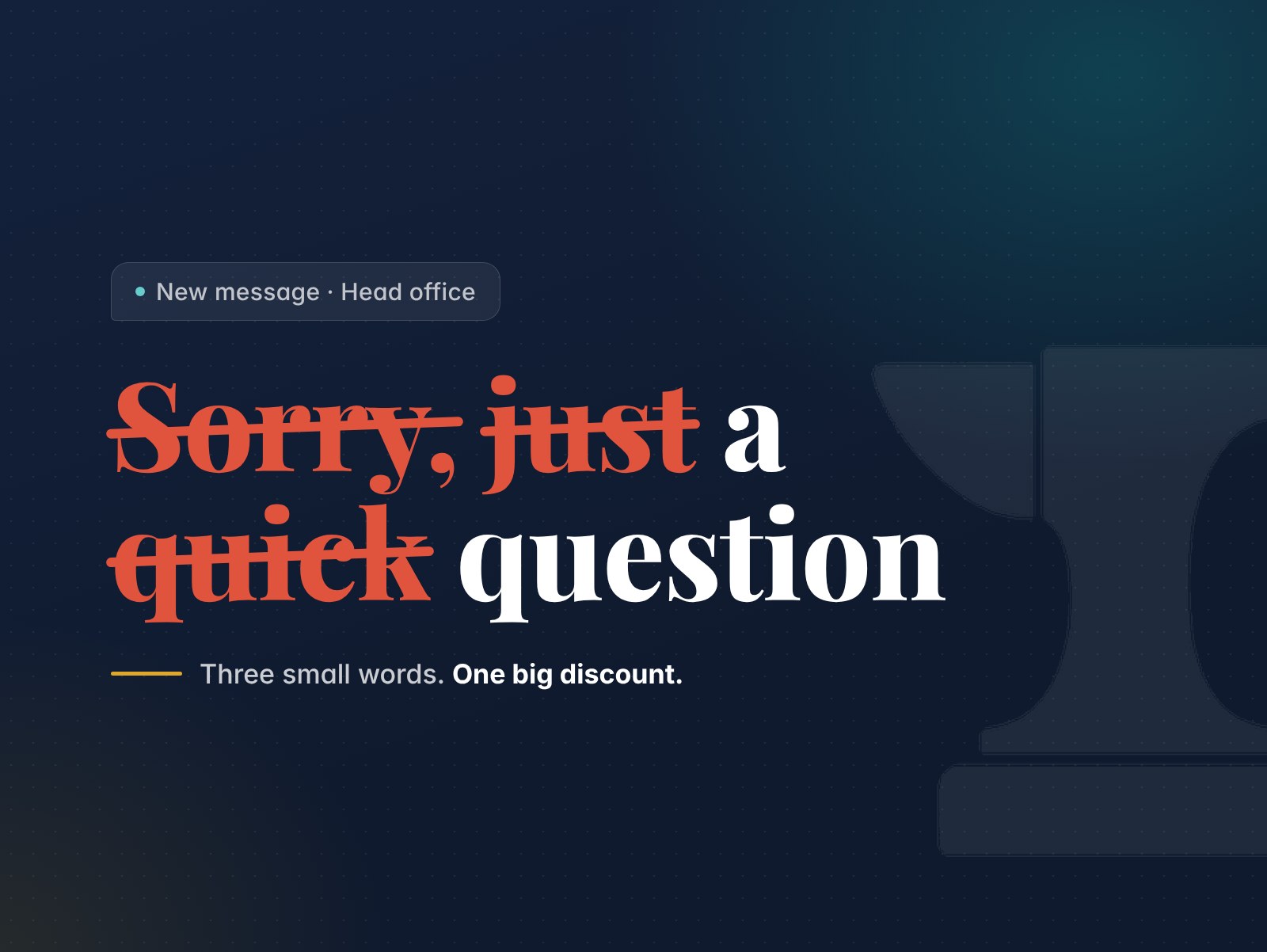
We took the written version of this habit apart in Sorry, Just a Quick Question. Speaking is harder, because there is no search-and-delete. The habits have to change before you open your mouth. On camera there is a second layer too, which we cover in Executive Presence, Virtual and In Person.
How to close the gap
Six habits for the meeting AI can't attend for you
- 1
Write one sentence, not one page
Before the call, write the single sentence you need the room to remember. If you only get ten seconds, that's what you say. Everything else is support.
- 2
Say the number first
"Eleven days late, because of customs" lands. "There were some issues with customs, so it's a bit late" doesn't. Numbers sound certain in any accent.
- 3
Borrow the verb from your own email
If your email said "I recommend", say "I recommend" out loud. Keeping the same verb in writing and in speech is the quickest way to make the two versions of you match.
- 4
Stop after the point
No "does that make sense?", no "voilà", no summary of what you just said. A two-second silence after a clear sentence reads as confidence.
- 5
Use AI as a sparring partner, not a ghostwriter
Ask it for the three hardest questions your manager could ask about your update. Then answer them out loud, not in writing. Rehearsing out loud is what moves the habit into your speech.
- 6
Read your own recap
After the meeting, open the AI notes, whether they come from Claude, Copilot or Zoom, and look for your name. If it isn't next to a decision, an action or a number, find the sentence that disappeared and work out why.
What this looks like in practice
A project lead reporting to a regional head office
A project lead in Casablanca sends weekly updates to a head office in Paris. Since the team started using AI tools, her written updates read crisp and senior. In the Thursday video call, she presents the same update in English she translates from French as she goes. It comes out cushioned and hesitant, and the regional director asks her to "just send it in writing". The director wasn't being unkind. He trusted the email more than the call.
Her English didn't need more vocabulary. Her spoken sentences needed the same order as her written ones.
1
Sentence prepared before each call
First
Where the number now goes
Same
Verb in the email and in the call
An illustrative composite of patterns we see across operations and project teams, not a single named client.
Questions people ask us
Should I stop using AI for my emails?
No. Use it for what it does well, which is clarity, structure and catching mistakes. Just don't let it become the only place your English sounds senior. Every phrase you accept from it is one you can practise saying.
AI already sits in our meetings. Doesn't that make speaking matter less?
It makes it matter more. Claude Meetings and the assistants built into Teams, Zoom and Meet attend as listeners, not speakers. Everything you say becomes a written record that outlives the call, and the meetings that decide budgets, promotions and contracts still need you to do the talking.
My English is fluent. Why do I hesitate more in meetings than in writing?
Because speaking leaves no time to edit, the habits of your first language take over: the courtesy formulas, the long run-up before the point. That's normal, and it's a habit to train, not a language level to fix.
Can a team learn this, or is it individual?
Both. Whole teams share the same habits because they share a first language and a company culture. We train teams on the meetings they actually run, from beginners to senior managers, and the fastest gains usually come from changing a few shared patterns.
What to take away
- Three in four professionals run emails to their boss past AI, so a polished email no longer sets anyone apart.
- Meetings are now where people judge your thinking, live and unedited.
- When your written and spoken English don't match, people trust the version they hear.
- AI now sits in the meeting too, taking the notes. It keeps decisions, owners and numbers, and hedged contributions tend to disappear.
- Close the gap by preparing your spoken English like your written English. One sentence, number first, same verb, then stop.
Based on 5,000+ hours training professionals at Deloitte, Baker Tilly and Kedrion across four continents.
Make your meetings sound like your best email
We build programmes around the conversations your people actually have, like the update to head office, the client call or the budget review. Book a free 30-minute demo with Daniela. It's a video call, and there's nothing to prepare. Become a Talksmith. Speak The Language Of Success.
Statistics are quoted as published by the sources named alongside them. Scenarios marked “what this looks like in practice” are illustrative composites of patterns across our programmes, not the results of a single named client.